


Personnage
Marrow Ashlowe
Aussi appelé Mar, Mother Ashlowe, the Sour Ashlowe (neighborhood gossip's name for her, never said to her face)
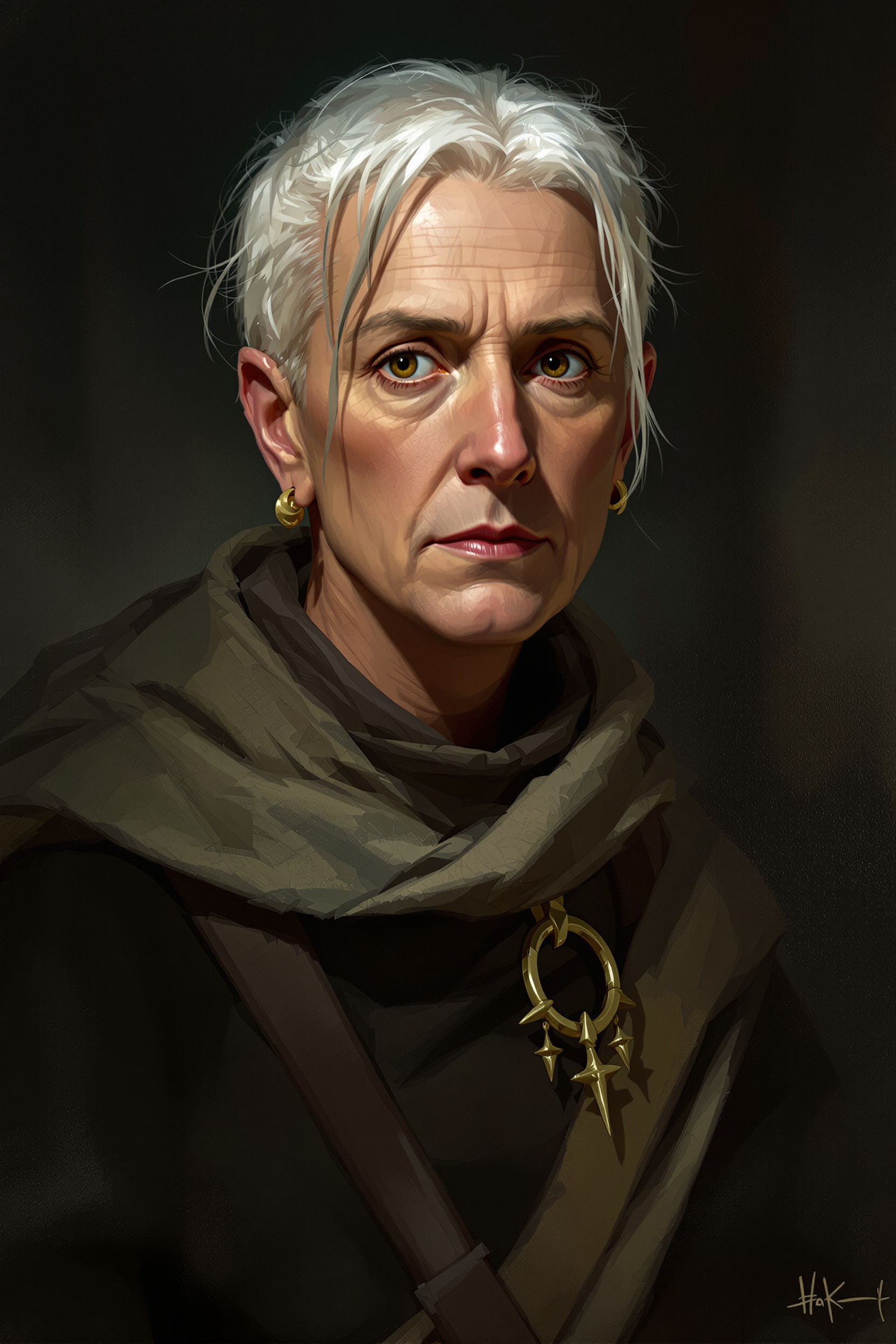
Physical & Factual
Marrow Ashlowe is fifty-eight in YP 1,412 and was about thirty when she had Wren. She is small, wiry and broad-handed, with hair that went white years too early and is kept cropped so it never gets in the way of her work. Her eyes are wide-pupiled and dark-adapted like everyone's on the Nightward, and she squints and turns her face from any warm-well glow that runs brighter than it should. The souring of her pact shows in small, odd ways rather than dramatic ones. Her hands are always cold, so she wears layered wool and mole-goat felt and sleeps close to compost heat. Knots she ties work loose by morning. Echoes in a room she has just entered come back a beat late, as if the quiet were reluctant to settle around her. Tools she once bent with a thought now answer only when she asks twice, politely. Once she was one of the finest dark-benders in her district, and the old skill still shows in her hands and in how she moves through a dark room without touching anything. The family pays the debt in installments. Suggested detail, to be checked against the Pact document: on each of the five Slack Nights the Ashlowes leave something of value on the household threshold, such as a warm coat, a good meal, a year's worth of a favorite habit, or a knurl-weight of something they can't spare. Marrow keeps the ledger of these payments in her head and nowhere else. The household's wider family is left open for the author, with no siblings or spouse named here so as not to collide with the existing cast.
Emotional Profile
Underneath the dry humor Marrow carries a steady, worn-in guilt, the kind a person learns to live with the way they live with a bad knee. She does not hate the Dark, and that surprises people. She blames herself, and a little unfairly, since the Dark kept its side of the bargain to the letter. She is proud, and her pride makes asking for help feel like handing over a coin she can't spare. Her humor is armor and also genuine: she is the source of Wren's dryness, and the two of them can trade deadpan lines across a table while a real conversation goes unsaid underneath. She feels deep tenderness toward Wren that she shows badly, fear of being found out, and a private hope she barely lets herself name, which is that her daughter might be the one to get them out. When that hope turns out to involve light, her fear and her relief arrive in the same breath and she can't tell them apart. She cries rarely, and in front of other people never.
Motivations & Psychology
Want: to keep Wren from paying one mite more than she already has. Marrow would rather carry the whole debt herself and quietly renegotiate it in the dark, in private, than let her daughter learn its true terms. Flaw: secrecy dressed as protection. She believes that telling Wren the truth would hand Wren the debt, so she withholds it, and the withholding is exactly what pushes a curious daughter to go digging alone, into the Hush Libraries, into the Rim, and into the reach of Odalys. Lie she believes: that what a child doesn't know can't be collected from her. Need: to trust Wren with the full account, and to see that her daughter is a partner and not another thing to be kept safe in the dark. The half-told truths come in layers, so the author can reveal them across the book. Layer one, told to Wren: Marrow bargained in a lean Round for warmth and security for a household in trouble, and the price grew when she couldn't keep up. Layer two, told to neighbors: she bargained to cure or protect someone and paid for it. Layer three, the recommended truth, which is Open and the author's call: before Wren was born, Marrow asked the Dark to hide something in her unborn child, the seed of a gift that would have been dangerous to the child if it surfaced. The Dark kept the bargain, the gift outgrew the hiding, and the debt is the cost of a concealment that is now failing. That would make Wren's light-bending the unraveling of her mother's pact and not a betrayal of it. Suggested optional thread, to tie into the main plot: Marrow once knew Odalys Verrenhold, as a junior colleague or a student of the same circle, and her pact was shaped by something she saw or guessed about light and the burned settlement. That would give Odalys a reason to draw Wren close and to fear Marrow's memory. If the author prefers, the link stays unspoken until late.
Voice & Expression
Marrow talks in short, dry, practical sentences, with proverbs that sound homespun and turn out to be bitter. She has the habit of the Nightward in her speech, so she describes things by temperature, texture and sound and rarely by sight. She reaches for the Dark's courtesy-phrases even when she is angry. Her humor runs deadpan and understated, and she undercuts big feelings with small tasks. Sample lines, to be adjusted against the Languages and Humor document: 'The Dark keeps good accounts. It's the rest of us who round up.' 'Have you eaten? No. Sit. Sit and then tell me you're fine.' 'Ask me something I can answer with soup.' 'I didn't lie. I chose which true thing to stand in front of you.' 'Don't thank the Dark in that tone. It can hear a sneer.' To Wren, when she finally breaks: 'I wasn't keeping it from you. I was keeping it off you. There's a difference, and I'm only now noticing it's a small one.' When she is afraid she gets quieter and more polite, not louder.
Relationships
Wren Ashlowe
Her daughter and the center of her life. They share a dry wit, a stubborn streak and a habit of hiding feelings inside jokes. Marrow's secrecy is the main strain between them, and Wren's curiosity is the force that eventually breaks it open. Marrow is proud of Wren's gift and afraid of it in the same breath.
Magistra Odalys Verrenhold
The most dangerous link in the cast. In the recommended version Marrow knew Odalys years ago and holds a piece of what happened, and Odalys's interest in Wren is not an accident. Marrow distrusts Odalys's warmth on instinct, without proof, and can't warn Wren without confessing the very things she has kept hidden. This is where her silence costs the most.
Pellam Quill
She approves of him at once and feeds him whenever he visits. Their deadpan exchanges are a joy to write, and she treats his blindness as an ordinary fact, never a pity, which he values. She quietly understands what a pact can take, and he is the one person who can ask her a direct question about it and get a straight answer.
Tamsin Corvane
She sees his failing pact in his cold hands and his tired courtesy before he says a word. It is like looking at herself years ago, and she softens toward him quickly. She is also the first to warn Wren, gently and not very usefully, that being drawn to someone and being the cause of their trouble are different things.
Isaura Thornmere
The Thornmere family's sound pact stands for everything the Ashlowes lost, and Marrow has endured years of polite, pointed sympathy from them. She holds no grudge against Isaura herself, whom she sees as a clever girl standing in the wrong place. Marrow can be the one to point out, late, that Isaura's family's trust and her own family's debt may be tied to the same truth.
Brindle Hask
Suggested: Marrow and Brindle are old acquaintances. Marrow has bought warmth and news from Brindle's warm-well for years, sometimes on credit she is embarrassed about. Brindle's over-sharing is a hazard to a woman built on withheld truths, and Marrow has more than once had to pay to keep a story quiet.
Warden Corvin Delacroix-Sable
He comes to her door with polite questions about unlicensed light. She answers every one with a true but incomplete statement, which is her specialty, and he is honest enough to notice. Over time his integrity gives her someone she can eventually say the real thing to without it being used against her daughter.
Junebug Tallow
She bullies Junebug into eating and takes his news with a raised eyebrow. He is the one messenger she trusts with a message for Wren, and she pays him extra in small coins and large portions. He gives her a taste of the family she might have built under easier terms.
Hesper Vael
Suggested hook, left Open: the two women may have met in the years after the settlement burned, and Marrow may have heard Hesper's account and said nothing. If the author wants it, this is a quiet, late beat that explains why Marrow has been so frightened of the truth for so long.
Development Tracking
- Opening: Marrow is warm, tart and constantly feeding people, and she runs the household with a practical briskness that hides how heavy the debt is. She gives Wren the safe version of the story, and her silences read as ordinary maternal stubbornness.
- First cracks: Wren's gift begins to show and Marrow notices before Wren admits it. She reacts with sudden, uncharacteristic fear, over-feeds her, changes the subject, and tries to steer her toward safer paths. The reader first sees that the debt is not just money.
- Escalation: as Wren digs, Marrow tells a second, partial story to head her off, and then a third. Each is true and none is complete. Wren catches the contradictions and they have their first real quarrel, one that stays dry and funny even while it hurts.
- Midpoint: a visit from the watch or a glimpse of Odalys shakes Marrow badly. She makes a private decision to renegotiate with the Dark alone, at personal cost, and the cost starts to show on her. Wren sees it and understands that her mother has been quietly paying more than anyone knew.
- Crisis: the full terms come out, whether through Wren's research, Pellam's work or Marrow's own confession. Marrow learns that her protection and her silence were the same thing, and Wren learns that the debt may be tied to the gift she has been afraid of. Their anger passes quickly, because both of them are practical.
- Resolution: Marrow stops trying to protect Wren by withholding and joins her as an equal, giving her the sealed thing and the ledger she kept in her head. She helps unmask the real danger and takes part in the final bargaining. She stays human: she keeps the soup, the humor and the coat-counting.
- Ending: the debt is not erased for free, since moral ambiguity is low and the book will want a clean, earned outcome. It is renegotiated, shifted or paid down in a way that costs something real and leaves the Ashlowes lighter. Marrow's closing gesture is her nightly greeting to the Dark, said now without strain, and an invitation for Wren to say it with her.