
AI Generated Paragraph: Make It Sound Like You
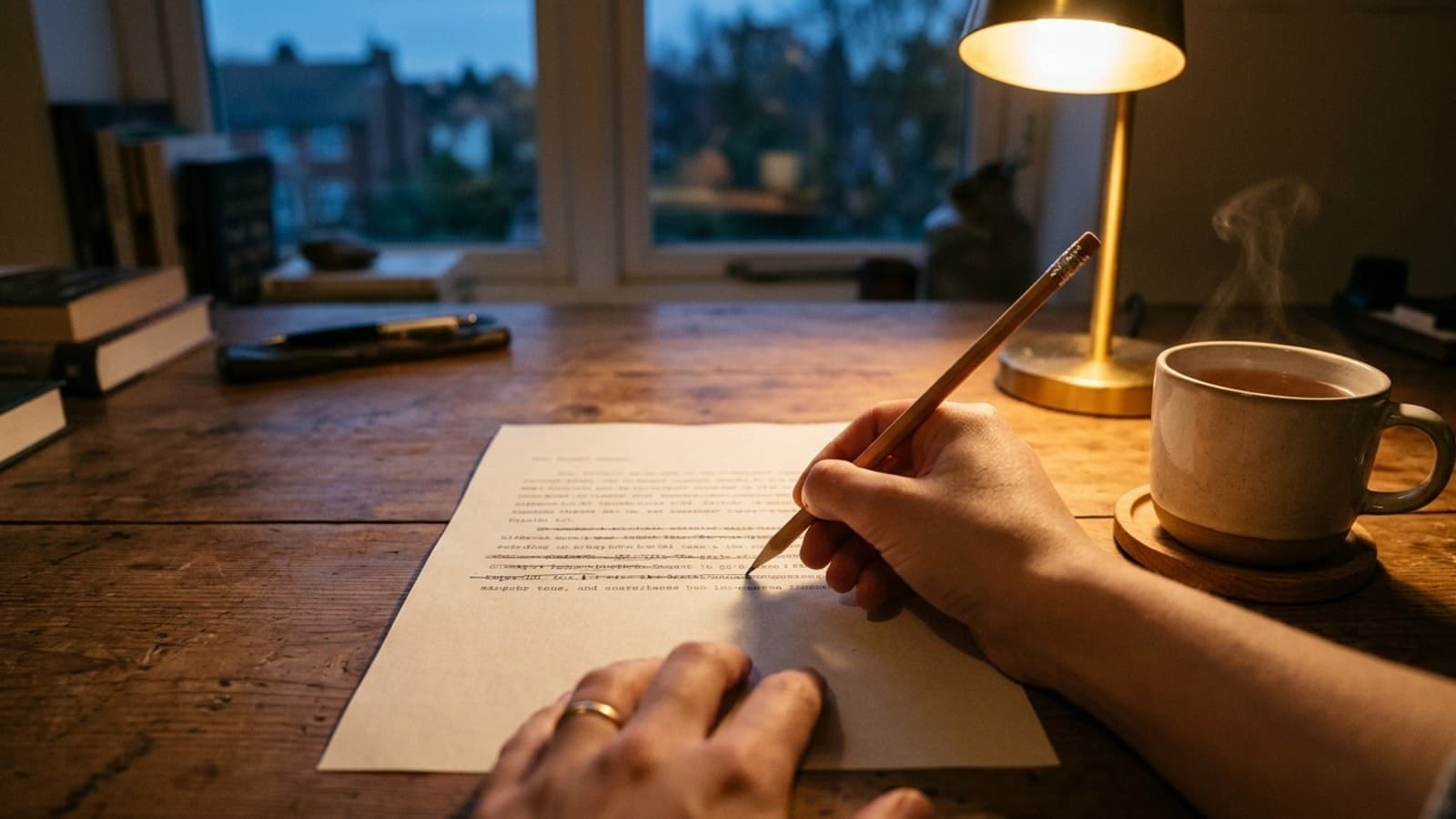
How to get an AI generated paragraph worth keeping: write a better prompt, spot the tells, and fix the flat rhythm, whether you write essays or novels.
An AI generated paragraph is a block of text a language model writes by predicting, word after word, what is most likely to come next. You can get a usable one in seconds from almost any free tool, but the first result is usually flat and generic, and it needs your edits before it sounds like a person wrote it. If you write fiction, the goal is different again: not a "perfect paragraph" but one that fits a scene, a character and a voice you already have.
Here is what matters most:
- A raw AI paragraph is a draft, not an answer. The sameness shows up in the rhythm and the word choices.
- A good prompt names the audience, the tone, the length and the concrete details. A bare topic gets you filler.
- You can spot the tells yourself: even sentence lengths, stock words like "tapestry" and "delve," and openings that summarize instead of showing.
- Detectors are not a reliable judge, so edit for quality rather than to pass a checker.
- For fiction, the best use is as a sounding board for a scene you are stuck on, with your own plan and voice steering it.
How an AI generated paragraph gets made
Large language models are trained on huge amounts of text and learn which words tend to follow which. Ask for a paragraph and the model builds one by choosing a likely next word, then the next, then the next. That is why the output reads as smooth and plausible. It is also why it reads as average: the safest next word is, by definition, the most common one.
Most free generators wrap this in the same simple layout. You type a topic, pick a tone such as formal, creative or persuasive, set a length (the tools I looked at range from roughly 50 to 250 words), and copy the result. Canva's Magic Write, for instance, accepts prompt instructions up to 200 words and gives free accounts 50 uses in total. Scribbr's paragraph rewriter handles up to 125 words per paragraph. Those limits are worth knowing, because they tell you what these tools are built for: short, tidy blocks of explanatory text.
That design works for an email or a product blurb. It does less for a scene in a novel, where a paragraph has to carry pacing, point of view and a character's particular way of noticing things.
How to write a prompt that gets a usable paragraph
The most common reason a generated paragraph disappoints is a prompt that says almost nothing. "Write a paragraph about a storm" gives the model nothing to be specific with, so it falls back on the most common storm paragraph in existence.
Give it four things instead:
- Objective. What must this paragraph do? Introduce a threat, slow the pace, reveal that a character is lying.
- Audience and viewpoint. Who is reading, and whose eyes are we in?
- Constraints. Word count, tense, what to leave out ("no weather clichés, no rhetorical questions").
- Tone and concrete material. Two or three real details: the smell of the room, what the character is carrying, what they are hiding.
Compare "a paragraph about a storm" with "A paragraph of about 90 words, close third person, past tense. Mara is waiting on a ferry dock, pretending not to be afraid of the crossing. Dry, a little sardonic. Include the sound of the rigging and the cold coffee she is gripping. No lightning." The second one gives the model something to build on, and it gives you something to judge the result against.
How to tell an AI paragraph, and what to fix
Pages that teach "humanizing" tend to agree on a short list of tells. Once you know them, you can see them quickly.
Flat rhythm. One analysis from Leap AI describes typical AI sentences as sitting in a narrow middle range of 15 to 25 words, and suggests humanized text needs about a threefold difference in length between neighboring sentences. You do not need to count. Read the paragraph aloud. If every sentence takes the same breath, break one in half and let another run long.
Stock vocabulary. A Medium analysis of AI vocabulary flags words that turn up again and again: "tapestry," "delve," "realm," "explore," "landscape," "pivotal," "bustling," "paradigm." One of them proves nothing, but a cluster is a sign. Replace each with the plain thing you mean.
Summary openings and tidy endings. AI paragraphs love to announce their point first and wrap it up last. Cut the throat-clearing sentence at the top and the neat moral at the bottom, and you often have a better paragraph.
No specifics. Generic nouns, no names, no particular objects. Swap in one detail only your story would have.
A word of caution about automated "humanizer" tools: they promise a one-click fix, but the real work is structural, which means varying rhythm, cutting filler and adding something specific. Nor should you lean on detectors. One 2024 analysis from Lumi Humanizer reported real-world detector accuracy of 39.5% on unaltered text, falling to 17.4% after basic paraphrasing. That is a single vendor's analysis, so treat it as a rough signal, but it matches the broader picture: detection is shaky, and good editing is the only dependable standard.
And the generated text can genuinely persuade. A Stanford study of 4,829 Americans, reported by The Economic Times, found AI-generated arguments moved policy preferences and were rated about as persuasive and logical as human-written ones. Plausible and polished is easy for a model. Distinctive is the part that is still yours.
Using AI paragraphs for fiction without losing your voice
Nearly every ranking page treats paragraph generation as an essay or marketing task. Fiction gets almost no attention, and it is where the "one click" promise breaks down fastest. A scene paragraph depends on what came before it: who is in the room, what they know, what the last line left hanging.
The workflow that holds up is closer to co-writing than outsourcing. Use the model to test a character beat, to find the word you are reaching for, or to see three ways a scene could open. Then write the version that sounds like your book. Keep your own plan in charge: the more the AI knows about your characters, your world and your voice, the less generic its guesses.
That is the idea behind how Novelmint works. Minty, the built-in AI editor, reads your story, lays it out as chapters and beats, and works from a story bible that every chapter is written from. When you ask for a chapter, the AI writes it from your beats, your bible and a base voice you choose, such as The Minimalist, The Storyteller or The Wit, and the cost is shown first. You can write every word yourself, let the AI write every chapter, or mix the two, and how much help you take is your decision. If a scene is not working, you can revise and polish it one beat at a time, or run a Style check that finds habits common in AI-written prose and lets you keep only the changes you want. If you want to understand why unplanned output feels generic, why AI-written books don't feel like yours goes into it, and prose-first vs beats-first covers the planning side.
If you already use ChatGPT or Claude, you do not have to leave them. You can connect them to Novelmint over MCP and plan, edit and build your books from inside that app, so the assistant works on the same plan, characters and notes. Here is how that connection works.
When an AI paragraph is the wrong tool
Some paragraphs should stay yours. The first line of a chapter, the moment a character breaks, the sentence your whole book leans on: write those by hand, because the choices in them are the book. Use generation for the scaffolding, such as bridging description, a second pass at a flat transition, or a quick sketch to react against.
A simple test: if you cannot say why a sentence is there, it is probably filler, whoever wrote it. Cut it.
FAQ
Can I get a good AI generated paragraph in one try?
Sometimes, for short factual or promotional text, if your prompt names the objective, audience, tone and length. For fiction, expect to revise. Raw output tends toward formulaic phrasing and even rhythm, so plan on at least one editing pass.
How do I know if a paragraph was written by AI?
Look for even sentence lengths, stock words like "tapestry" or "delve," a summary opening and a tidy closing line, and a lack of concrete detail. No single sign is proof, and detectors are unreliable, so trust a close read over a score.
Is it okay to use an AI generated paragraph in my novel?
That is your call, and the rules depend on where you publish and what you disclose. On Novelmint you own the stories you make, including prose the AI writes from your plan, and they publish under your name or a pen name. Books are labelled where AI agents wrote them, so readers know what they are choosing.
How do I make an AI paragraph sound less robotic?
Vary the sentence lengths, cut the opening summary and the neat conclusion, replace stock words with plain ones, and add one specific detail only your story would have. Reading it aloud is the fastest test.
What should I put in the prompt for a scene paragraph?
The purpose of the paragraph, whose viewpoint it is in, the tense, the word count, the tone, and two or three concrete details such as an object, a sound or something the character is hiding. Add what to avoid, like clichés.
Do free paragraph generators have limits?
Yes. The ones I checked cap input and output sizes: Canva's Magic Write takes prompts up to 200 words with 50 free uses, and Scribbr's rewriter handles up to 125 words per paragraph. They suit short blocks, not a whole scene with its history.
If you want to try the planned approach, start a book on Novelmint and the first chapter of your first book is written at no charge.