
Plan for a Story: A Step-by-Step Method That Holds
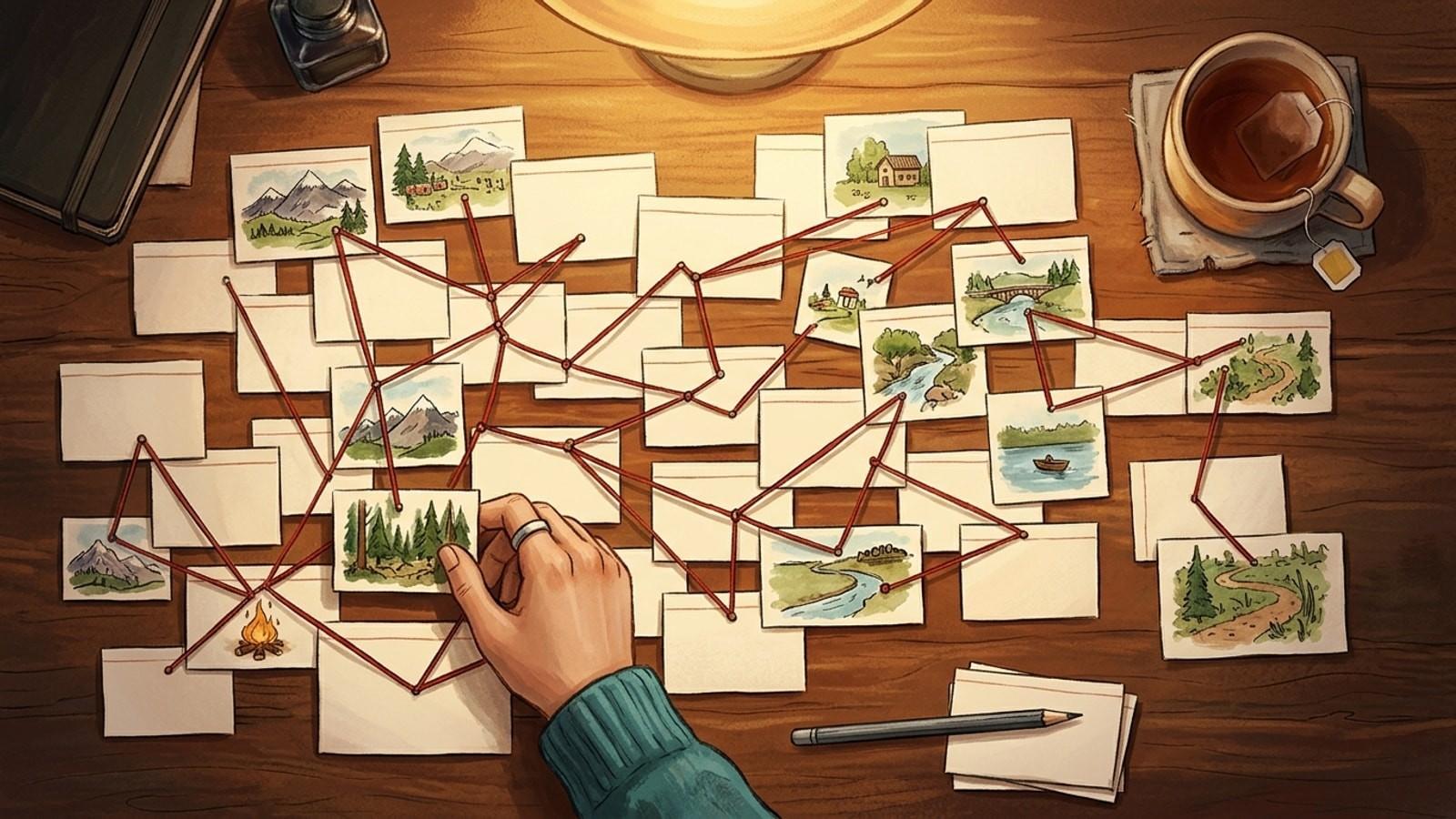
A plan for a story in six steps: premise, character, structure, scenes. Includes the 7 parts of story structure, the 5 C's, and short story tips.
A plan for a story is a short working map that turns a spark of an idea into a sequence of scenes before you draft: who wants what, what stands in the way, how it ends, and what happens in between. It doesn't need to be long or rigid. The best plan is the smallest one that stops you getting lost, and you can build a usable one in under an hour.
Here is what to hold onto:
- Start with a one-sentence premise: a character, a want, and an obstacle.
- Plan your character's inner change, not only the events. Plot beats land harder when they push on what the character believes.
- Pick a structure that fits your length. A short story, a novella and a novel need different shapes.
- Break the structure into scenes, and make sure each one has conflict and changes something.
- Budget your length before you outline, so the middle doesn't bloat and the ending doesn't rush.
Start your plan for a story with one sentence
Before outlines, before worldbuilding, write one sentence: Someone wants something, but something stands in the way. Then sharpen it. Who is the someone? What exactly do they want? What is the obstacle, and what happens if they fail?
"A grieving lighthouse keeper must reach the mainland before the storm, but the only boat belongs to the man she blames for her husband's death." That is enough to plan from. You can see the want, the obstacle, the clock and an emotional knot.
If you can't get the premise into a sentence, the story usually isn't ready to outline yet. Spend ten more minutes here. It is the cheapest fix you will make all project.
Plan the person, not just the plot
Most planning advice treats a story as a chain of events: inciting incident, rising action, climax. That chain works better when you tie it to what is happening inside your protagonist.
Give your main character three things:
- A want. The outside goal, such as reaching the mainland.
- A need. What they must learn or face, such as forgiving or letting go.
- A misbelief. The false idea steering them, such as "if I never depend on anyone, I can't be hurt again."
Now every major turn in your plan can pressure that misbelief. The midpoint shouldn't just be "something big happens". It should be the moment the character's old strategy stops working. When your plot beats and your character's inner shift line up, the story feels inevitable rather than arranged.
Pick a structure that fits your length
Many planning guides force one structure on everything. Don't. Match the shape to the size.
The 7 parts of a story structure
The question comes up constantly, and there are two common answers. The most widely taught is the 7-point plot structure: Hook, Plot Turn 1, Pinch 1, Midpoint, Pinch 2, Plot Turn 2 and Resolution. It works because it anchors the story with a beginning, an end and a hinge in the middle, then fills in the pressure points between them.
A different "seven" comes from Jeff Lyons, who lists seven elements rather than seven plot points: Character, Constriction, Desire, Focal Relationship, Resistance, Chaos/Adventure and Change. It reads more like a checklist of ingredients than a timeline, and it is a good test for a draft: if one is missing, you can usually feel the gap.
The 5 C's of a story
The 5 C's are a lighter framework often used for short pieces: Context (the circumstances), Catalyst (the challenge that disrupts them), Complication (the conflict that grows), Change (the climax) and Consequence (the closure). It is quick, and it suits a short story or a single chapter.
How to create a short story plan
For a short story, try the 7-beat framework from writing educator Abbie Emmons: Set the Container, Inciting Incident, Escalation and Complication, Midpoint Shift, Confrontation, Choice, and Aftermath. Notice the Choice beat near the end. A short story usually turns on one decision, so plan toward it deliberately.
Whatever framework you choose, treat it as scaffolding. If the story wants to break the pattern, let it, as long as you know why.
Budget your word count before you outline
This is the step most guides skip, and it prevents the two classic problems: a sagging middle and a rushed ending. Decide your length first, then decide how many scenes it can hold.
According to the Chapter Blog's structure comparison, a novella of 17,500 to 40,000 words typically runs 15 to 30 scenes with one point-of-view character (two at most), up to one subplot, three to six named characters and one to three settings. A novel of 70,000 to 100,000 words typically runs 60 to 90 scenes, with one to five viewpoint characters, two to four subplots and eight to fifteen named characters. The Science Fiction and Fantasy Writers Association, which runs the Hugo Awards, defines a novella as 17,500 to 39,999 words.
Use those as rough guides, not rules. If you plan 90 scenes for a 30,000-word story, you have already found the problem. Novelmint's free word count by genre calculator and writing pace calculator can help you set a target length and a schedule that gets you there.
Turn the structure into scenes
Now break each section into scenes. For each one, write a single line covering who is in it, what they want, what blocks them, and what is different by the end. That last part is the test. If nothing changes, the scene probably isn't earning its place.
This is also where practical tips for writing better come together:
- Give every scene conflict, even a quiet one.
- Raise the stakes as you go, not just the noise.
- End scenes on a shift: a decision, a revelation or a new problem.
- Keep a list of promises you make early, such as a gun on the wall or a secret, and plan where they pay off.
Different methods take different amounts of time. The Story Planner site estimates about 20 minutes for a simple story structure, 30 for an index-card plan, 45 for the Snowflake Method and 60 for a detailed character outline. Pick the one that matches how much certainty you need before you start writing.
If you're writing a serial: plan for readers who come back
Almost every planning guide assumes a single, standalone book. If you plan to publish chapter by chapter, the plan changes. Each chapter has to work as a satisfying unit and also pull the reader forward, so you plan chapter endings and long threads on purpose. Mark where each thread starts and ends, and decide where the cliffhangers fall.
Planning a story on Novelmint
If you want somewhere to do all this, Novelmint's planning tools are built around scenes. Describe your story to Minty, the built-in AI editor, and she lays it out as chapters, beats (scene-by-scene plan points), characters and plot threads while you watch. You can plan a book with Minty step by step, approving small proposals, or ask her to run ahead.
On the Timeline in the Studio, you see the whole book as chapters of beats in one scrolling view, with colored lines showing each plot thread weaving through the chapters it runs through. Each chapter has a color band for its point-of-view character, and a progress bar measures the book against your own plan. A story bible keeps your notes on characters, places and world rules in one place. You can run a continuity check later to catch contradictions.
If you would rather go from idea to a drafted book, Build a book takes you there. You answer its questions (or talk them through with Minty, who offers example answers), and agents work from your Story Profile through the world and cast, the story arc, a continuity check and each chapter, one step after another. You can find them on the agents page.
You can also connect an AI app such as Claude or ChatGPT to Novelmint over MCP and plan from inside that app, working on the same plan, characters and notes. See /mcp for how it connects.
Planning is free to try, and the first chapter of your first book is written at no charge. See plans and credit prices for the rest.
FAQ
What are some tips for writing better?
Plan around change. Make sure every scene has conflict and leaves something different, tie plot events to your character's inner shift, and cut anything that doesn't move either. After drafting, read the story aloud and look for places the stakes go flat.
What are the 7 parts of a story structure?
The most common answer is the 7-point plot structure: Hook, Plot Turn 1, Pinch 1, Midpoint, Pinch 2, Plot Turn 2 and Resolution. A second set from Jeff Lyons lists seven elements instead: Character, Constriction, Desire, Focal Relationship, Resistance, Chaos/Adventure and Change.
How do I create a short story?
Start with a one-sentence premise, then pick a compact structure such as the 7-beat framework: Set the Container, Inciting Incident, Escalation and Complication, Midpoint Shift, Confrontation, Choice and Aftermath. Keep the cast small, one main character and few settings, and plan toward a single meaningful decision near the end.
What are the 5 C's of a story?
Context, Catalyst, Complication, Change and Consequence. Context sets up the circumstances, the Catalyst disrupts them, the Complication escalates the conflict, the Change is the climax, and the Consequence is the closure. It is a quick frame for short pieces.
Start with the smallest plan that works
You don't need a binder of notes. You need a premise, a character who wants something and believes something wrong, a structure that fits your length, and a handful of scenes that each change something. Start there, and revise as the story teaches you what it wants. When you're ready to try it, you can start writing a book and have your first plan laid out in a conversation.