
world
The Twilight Rim and the Sunward Desert
The Twilight Rim and the Sunward Desert
Reference document. Covers the border zone between the habitable night side and the sun-side, the scorched desert beyond, and the new life and lights stirring there. For underlying physics see The Tidally Locked World. For pact and Balance mechanics see The Presence of Darkness and the Pact System and The Presence of Light and the Balance. This document covers only what happens at the edge and beyond it.
Provisional names: The two moons appear here only as "the greater moon" and "the lesser moon". Their proper names, phases and folklore belong to The Two Moons.
1. Summary
- The planet always shows one face to its sun. The dark side is where people live. The sun side is a desert of glare and heat.
- Between them runs a ring of permanent dusk, the Seam (the terminator line). It is about 20,000 km around.
- The sun never moves. At the Seam it sits on the horizon like a half-buried coin. The light is soft and orange and deeply unwelcome.
- For as long as records exist, the Sunward Desert was empty. In the last few decades it has begun to glitter, flicker and move.
- Nobody on the dark side knows what the new life and lights are. Everyone has an opinion. Most of the opinions are loud.
2. Zone Map (dark side to sun side)
Distances are measured from the Seam. "Out" means toward the sun.
| Zone | Distance | Light | Temperature | Settled? | Bending |
|---|---|---|---|---|---|
| Deep Dark | over 1,500 km dark-ward | Moonlight only | Cold, −25 to 0 °C | Yes (heartlands) | Strong, easy pacts |
| Dimlands | 1,500–400 km dark-ward | Moonlight, faint sky-glow near the edge | −10 to 8 °C | Yes (frontier towns) | Strong |
| The Gloam | 400–0 km dark-ward | The Pale, a dim sky-glow from the hidden sun | 5 to 18 °C | A few stations only | Thinning |
| The Seam / Long Edge | ±30 km | Sun-disc on the horizon, fixed | 15 to 35 °C | No | Faint, unreliable |
| Scorch Margin | 0–250 km out | Full low sun | 40 to 90 °C | No | Almost none |
| The Glare (open desert) | 250–8,000 km out | Climbing sun | 90 to 150 °C | No | None reported |
| Stillnoon | the sun-side center, about 10,000 km out | Sun directly overhead | about 180 °C | Unknown | Unknown |
The dark side is the planet's coldest and safest region. The Gloam is the only zone on the whole planet with a mild climate. Everyone knows this, and nobody wants to admit it.
3. Physical Rules at the Edge
The sky
- The Pale. In the Gloam the sun is below the horizon. The sky has a dim, steadily brightening glow toward the sunward edge, like a lamp under a door. The Pale begins around 400 km from the Seam. At 100 km it is bright enough to read by, which is why every reasonable person avoids it.
- The Sun-disc. At the Seam the sun is a half-disc on the horizon. It does not rise and it does not set. Shadows are very long and fixed. The shadow of a post stays exactly where it fell, so rim travelers use these shadows as compass lines.
- Moonlight reversal. At the Seam both moons are low and often behind the sun-glare. Moon-based timekeeping becomes unreliable. Rim crews count time in sleeps and meals instead of moon-phases.
Wind
- The Sunward Draw. Hot air over the Glare rises. Cold air flows in along the ground from the dark side to replace it. Travelers going out have a steady tailwind. Travelers coming back have a headwind, and every rim traveler complains about it.
- The Return (the high wind going the other way) cannot be felt at ground level. It carries moisture back over the dark side, where it falls as snow. Stinging snow in the Dimlands means the sun side has been busy.
Water and fog
- The Hemfog. Where the warm Glare air meets the cold Draw, a wall of fog forms along most of the Seam. It is 5 to 40 km thick and glows faintly orange. It is a hazard to navigation and a handy hiding place.
- Thawruns. Meltwater streams from the dark-side ice fields reach the Gloam and run toward the Seam. Most boil off before the Scorch Margin. They are the only dependable freshwater near the rim.
Ground
- Gloam ground is frost-cracked grit, lichen mats and blackmoss.
- Scorch Margin ground is baked clay with a hard crust. The crust cracks loudly underfoot and makes sneaking impossible.
- The Glare proper has ash-colored plains, dune fields and a vast sheet of fused sand called the Glass Sea.
4. The Gloam: Edge Settlements and Stations
Only a handful of places exist at the edge. Full descriptions belong in Atlas of the Dark Side.
- Hushmark. The last true town, about 320 km dark-ward of the Seam. It lives on rim trade, survey work and persistent rumor. Its custom of speaking softly is practical (sound carries oddly in the Pale) and also superstitious.
- The Cairns. Twelve waystations along the Gloamroad, numbered from Cairn One (nearest Hushmark) to Cairn Twelve (about 20 km from the Seam). Each is a stone hut with a bender-kept pact-warmth and a message board. Cairn Twelve's board reads: "Turn back. We mean it kindly."
- Hemwatch posts. Small garrisons that monitor the Seam. They log every unusual light, record its color, and send reports to the capital. They are chronically understaffed and overworked. They are also, by general agreement, the funniest people on the planet. (Governance details are in Governance, Law and Politics.)
Pact-thinning in the Gloam. Benders say Darkness feels "far away, like a voice in the next room." Pacts still hold but are slower and less precise. Within the last 100 km, a bender must speak twice as long to get a response. This is the best-known edge effect and the one every newcomer has to be warned about.
5. The Seam and the Long Edge
- The Long Edge is the 60 km-wide strip centered on the Seam, where sun-disc and Hemfog dominate. It is not dark and not day.
- Dark-side people experience it as overwhelming, with an ache behind the eyes, tearing, and a feeling like being stared at. Most can stay only an hour or two without protection.
- Hoods and veils are standard gear: layered dark cloth with narrow slit-lenses of smoked sootglass. Dark-benders also hold small shade-pacts, which are short, stubborn agreements with Darkness to hold a patch of shadow around the wearer. They fail unpredictably in the Long Edge.
- The Sunwall is the local name for the Hemfog's brightest stretch, where fog and low sun combine into a glowing orange barrier. Wherever the Sunwall is brightest, strange lights have been most often seen beyond it.
6. The Sunward Desert
Scorch Margin (0–250 km out)
Baked clay and cracked crust. Daylight is constant and aggressive. A well-equipped crew with shade-pacts can survive here for a day or two, on the premise that every minute is costly.
The Ashplains
A wide belt of pale ash and dunes beginning around 250 km out. It is the first place new life was reported. Wind keeps the dunes shifting, which erases tracks.
The Glass Sea
A vast plain of fused sand. The surface is mirror-bright and nearly impossible to look at. Every strange light seen so far has been reported at or near its edges. Nobody knows whether the glass is old or new. Two surveys disagreed, politely and at length.
Stillnoon
The substellar center. No one has returned from within about 6,000 km of it. Reports of anything there are unverified.
7. The New Life and Lights (Catalog)
Every entry is based on Hemwatch logs, caravan testimony and rumor. The status line says how much is actually established.
Glints
- Appear: Scattered across the Ashplains and Scorch Margin as single white-gold pinpoints on the ground. They stay in place for hours, then vanish.
- Known: Seen since about 40 years ago. Count has grown sharply in the last 7. They do not seem to move.
- Danger: Low alone. Dangerous in clusters, since they dazzle and cause disorientation.
- Rim saying: "Never name a glint." (Crews who name them get attached to them, then wander out after them.)
Drifts
- Appear: Slow clouds of motes that float in from the Glare and thin out at the Seam.
- Known: Drift speed is steady, about walking pace. They seem to move toward the dark side. They fade when they cross into the Gloam.
- Danger: Medium. Contact leaves a painless warmth that lingers for days. Benders who touch one report their pacts going "quiet" for a while.
Glasswort
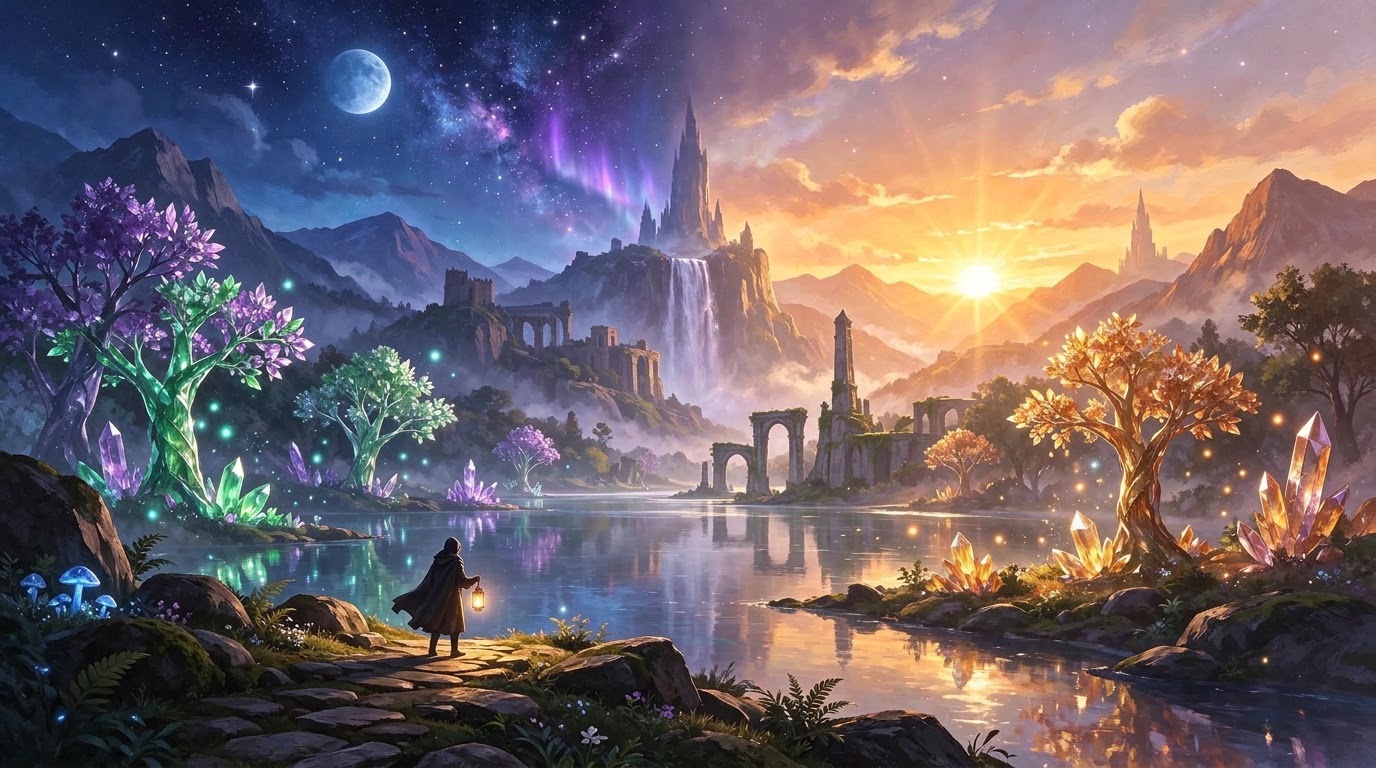
- Appear: Brittle crystal plants growing from the edge of the Glass Sea. Branches are spiky and clear. At certain times they glow from inside.
- Known: The only confirmed plant-like life. Samples taken to Hushmark have never survived the trip, but they have lit up in the dark for a few hours before crumbling.
- Danger: Low. Sharp edges only. The danger is in wanting to collect them.
Gleamhens
- Appear: Small, round, feathered creatures with a soft glow, found in the shelter of dunes in the outer Ashplains.
- Known: Docile, curious, vaguely chicken-sized. They follow travelers. They eat blackmoss and drink from Thawruns.
- Danger: None directly. A gleamhen in a dark-side home is a serious violation of light law. They are also, by every report, extremely good company. Smuggled gleamhens are one of the rim's open secrets. (See Economy and Technology for contraband prices.)
Shimmerwalkers
- Appear: Tall, narrow figures of bright heat-shimmer, seen only at distance across the Glass Sea.
- Known: Reported by at least nine independent crews. No one has ever gotten close. They seem to walk in lines, and they sometimes stop and turn toward Hemwatch posts.
- Danger: Unknown. Official classification: "Possibly nothing. Treat as everything."
Skyfolds
- Appear: Ribbons of colored light high above the Glare, visible from Cairn Eleven and Twelve on clear nights.
- Known: Appear most often just after a major dark-side pact event, such as a large bender gathering. Hemwatch has not yet agreed whether that is cause, effect or coincidence.
- Danger: None directly. They unsettle the Hemwatch, and everyone has noticed that nobody will say why.
8. Hazard Grades (Rim Field Classification)
A field system used by Hemwatch for rim phenomena only. The wider escalation of the Balance is defined in The Presence of Light and the Balance.
| Grade | Name | Meaning | Response |
|---|---|---|---|
| 1 | Flicker | Isolated glint or drift. | Log it. Do not name it. |
| 2 | Gather | Clusters, repeated sightings. | Notify Hushmark. |
| 3 | Lean | Lights moving toward the Seam or a post. | Pull back one Cairn. |
| 4 | Cross | Any phenomenon entering the Gloam. | Alert the capital. Evacuate Cairns Ten to Twelve. |
| 5 | Answer | A phenomenon responds to a bender or a post. | Everything stops. Everybody listens. |
No Grade 5 event has been confirmed. Three have been reported. Hemwatch refuses to discuss them.
9. What Is Known, Rumored and Unknown
Established
- Strange lights and life exist in the Sunward Desert and are increasing.
- Their numbers rise after dark-side pact surges.
- Drifts move toward the dark side and fade at the Gloam.
- Pacts weaken at the Seam.
Widely rumored
- Someone, somewhere, is bending light.
- The shimmerwalkers are people.
- Glints are eyes.
- The Hemfog is getting thinner.
Unknown (held for Book 1 reveals)
- Whether the new life is native and newly awakened, or arriving.
- Whether the Presence of Light is aware of the dark side, or of any particular person.
- Why drifts fade at the Gloam, and what happens when one does not.
- Whether any person has ever crossed the Glass Sea and returned.
- What the Skyfolds are answering.
Source reliability. Hemwatch logs are accurate and dull. Caravan testimony is vivid and unreliable. Hushmark taverns are neither.
10. Past Expeditions (relative dates)
Exact dates belong in Timeline of the World.
- The Long Walk. About 220 years ago, a party of twelve reached 180 km out and returned with seven. They brought back a map and a firm view that the trip was a bad idea.
- The Glass Survey. About 90 years ago, two competing survey teams mapped the edge of the Glass Sea. Their maps do not match. Each team accuses the other of error, and both are probably right.
- The Quiet Winter. About 11 years ago, a Hemwatch post at Cairn Twelve went silent for six weeks and then reported in cheerfully, as though nothing had happened. Their logs for the period are blank. No one has explained why.
11. Story Notes
Tone. The rim is the place where the warm, funny dark-side culture meets something it cannot joke its way past. Humor is the crews' defense, not a sign they are unafraid. The danger is real: dazzling, disorientation, being lost in the fog, and the pull of beautiful things that should be left alone.
Rules of thumb
- Characters cannot rely on bending at the Seam, so any scene there raises stakes automatically.
- Light causes harm (blindness, burns, confusion) but never gore. Rim stories favor near-misses and getting lost over casualties.
- The new life is wondrous and perilous in equal measure. Some of it is simply lovely, and loveliness is part of the danger.
- Characters who feel drawn toward the light should be written sympathetically. The pull is real.
Romance hooks. Shared shifts in a tiny Cairn. Two people pinned together under one shade-pact. A bender and a smuggler arguing over a gleamhen. The ache of the Long Edge as a shared secret.
12. Terms Introduced (for the Glossary)
Seam · Long Edge · Pale · Gloam · Dimlands · Deep Dark · Hemfog · Sunwall · Thawrun · Sunward Draw · the Return · Scorch Margin · Ashplains · Glass Sea · Stillnoon · Gloamroad · Cairns · Hemwatch · shade-pact · sootglass · blackmoss · Glints · Drifts · Glasswort · Gleamhens · Shimmerwalkers · Skyfolds · Hazard Grades (Flicker, Gather, Lean, Cross, Answer)